
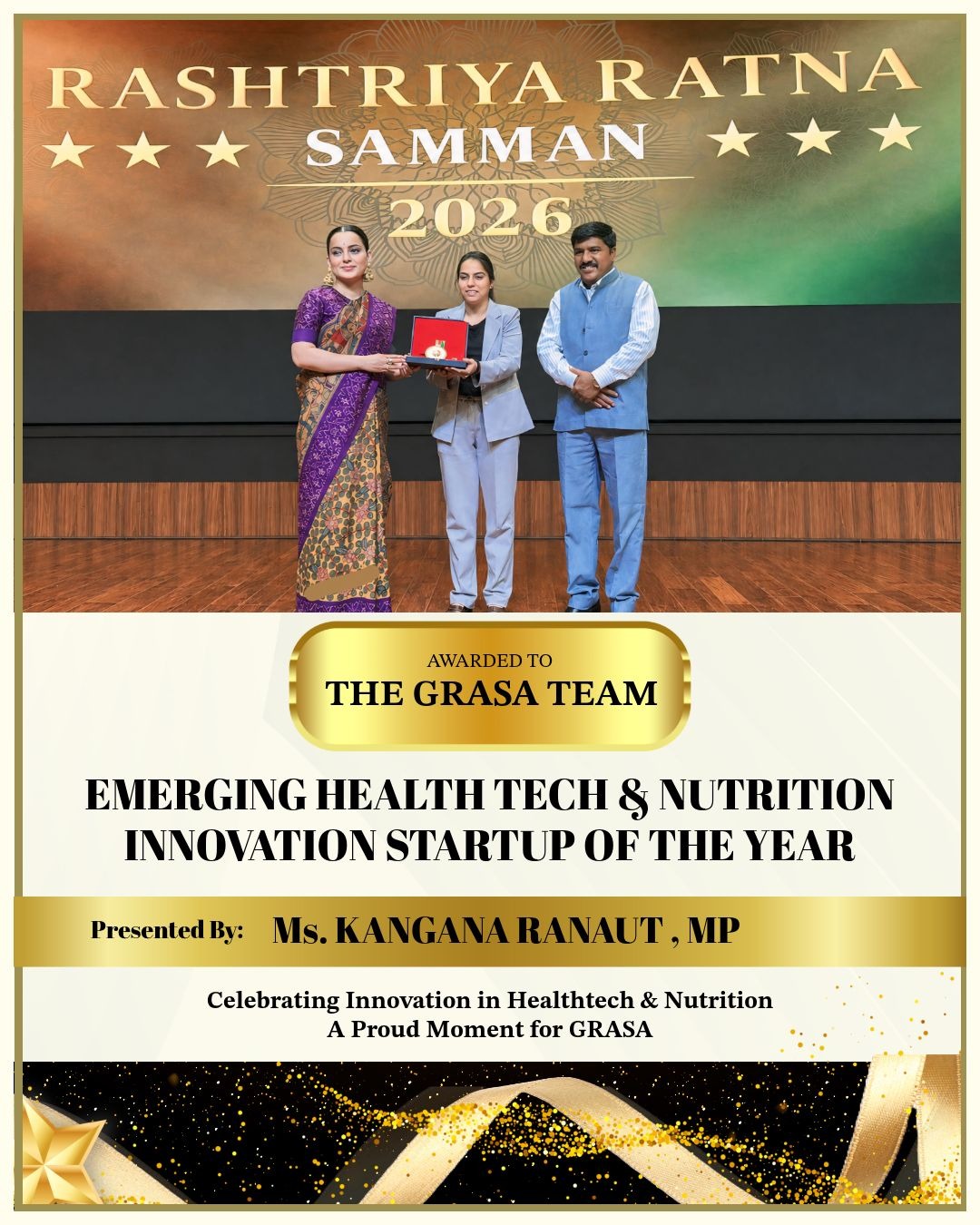
GRASA Recognised as India's Emerging Health Tech & Nutrition Innovation Startup of the Year — Rashtriya Ratna Samman 2026
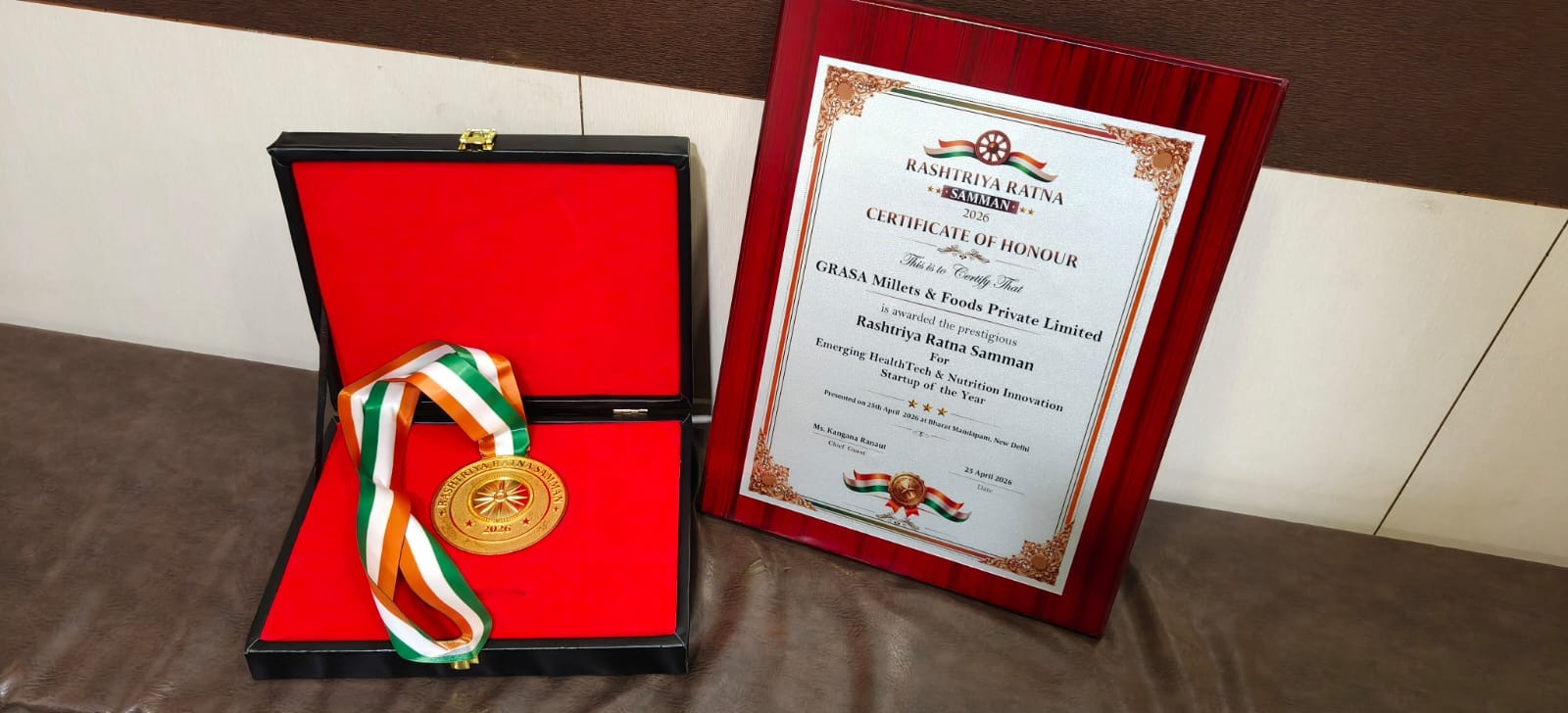
GRASA Millets & Foods Pvt Ltd — India's first food-led metabolic recovery system built on fermented millets — has been awarded the Emerging Health Tech & Nutrition Innovation Startup of the Year at the Rashtriya Ratna Samman 2026.
GRASA Editorial Team
April 1, 2026
GRASA Millets & Foods Pvt Ltd — India's first food-led metabolic recovery system built on fermented millets — has been awarded the Emerging Health Tech & Nutrition Innovation Startup of the Year at the Rashtriya Ratna Samman 2026. The award was presented by Ms. Kangana Ranaut, Member of Parliament, at a national ceremony recognising outstanding contributions across sectors.
For a company that has quietly been building at the intersection of ancient food science and modern metabolic research, this recognition marks a significant milestone — not as an arrival, but as a confirmation that the direction was right.
"India does not have a food problem. It has a metabolic collapse problem. And fermented millets are part of the answer."
What Is GRASA — And Why It Is Different
GRASA is not a health food brand. The distinction matters.
In a market crowded with multigrain snacks, protein supplements, and 'clean label' packaged foods, GRASA occupies a different category entirely: daily therapeutic nutrition, designed with clinical intent, built to repair a broken metabolic system from the inside.
The founding premise: that the epidemic of insulin resistance, PCOS, fatty liver disease, and hormonal dysfunction sweeping urban India is not a disease problem first — it is a daily nutrition problem. People are eating the wrong things, every single day, and their guts are paying the price.
GRASA's answer is fermented millets. Not as a superfood trend, but as a clinically validated food system — one that delivers short-chain fatty acids, improves the gut microbiome, stabilises post-meal glucose response, and reduces systemic inflammation over time, through daily consumption.
- Fermentation increases the bioavailability of nutrients in millets by up to 40–60% compared to non-fermented equivalents.
- Fermented millet consumption is associated with improved fasting insulin levels in metabolically compromised individuals.
- Short-chain fatty acids produced during fermentation feed gut lining cells, reduce intestinal permeability, and support immune regulation.
- Millet-based diets are associated with lower post-meal glucose spikes versus wheat-based equivalents, particularly in insulin-resistant individuals.
GRASA builds its food programmes on this science — not on marketing claims.
The Rashtriya Ratna Samman 2026 — Award Context
The Rashtriya Ratna Samman is a national recognition platform celebrating outstanding achievement and innovation across sectors — from entrepreneurship and healthcare to social impact and arts.
The 2026 edition awarded GRASA the Emerging Health Tech & Nutrition Innovation Startup of the Year — a category recognising early-stage companies driving meaningful change in India's health and nutrition landscape. The award was presented by Ms. Kangana Ranaut, MP — reflecting the national significance of the event and the calibre of contributions being recognised.
For GRASA, the award validates what its founding team has been building: a rigorous, outcomes-driven approach to metabolic nutrition that refuses to cut corners — on formulation, on clinical framing, or on the quality of results delivered to people.
"This award is recognition that food can be medicine — when it is designed with clinical intent."
India's Metabolic Health Crisis — The Problem GRASA Was Built to Solve
The numbers are stark. India now has over 101 million people living with Type 2 diabetes — more than any other country. Approximately 1 in 5 urban Indian women of reproductive age has PCOS. Non-alcoholic fatty liver disease affects an estimated 9–32% of the general population, with prevalence rising sharply in younger demographics. Insulin resistance — the common thread running through most of these conditions — is often present for a decade before diagnosis.
This is not a genetics problem. It is a food environment problem. Urban Indian diets — high in refined wheat, processed carbohydrates, and ultra-processed snacks — create a metabolic environment where the gut microbiome degrades, insulin sensitivity drops, and inflammatory markers rise. Standard medical care manages the downstream consequences. Very little addresses the daily food input that is driving the dysfunction upstream. GRASA was built to address the upstream.
Who GRASA Serves
GRASA's primary audience is women between 28 and 55 in Delhi NCR — working professionals and homemakers managing real metabolic burden: weight that will not move despite disciplined eating, persistent fatigue, hormonal irregularities, gut discomfort, and blood reports that are 'borderline' but not yet diagnosable. Women who are doing everything right and still not recovering.
The GRASA system does not replace their doctors. It addresses what medicine alone cannot: what goes into the body at 8am every morning. Daily. For months. Until the gut repairs, the insulin response stabilises, and the metabolic machinery starts working again.
The Science of Fermented Millets — Why This, Why Now
Fermented millets are not new. Kanji, ambali, koozh, and similar preparations have been part of Indian food traditions for centuries — consumed intuitively long before the language of gut microbiome or short-chain fatty acids existed.
What is new is the clinical validation. Research published in peer-reviewed nutrition journals over the past decade has begun to formally document what traditional food cultures understood empirically: that fermentation transforms millets into a significantly more bioavailable, gut-supportive, and metabolically beneficial food.
Glycaemic control
Fermented finger millet (ragi) has been shown to produce a meaningfully lower post-meal glucose response compared to non-fermented preparations — and substantially lower than refined wheat flour. For insulin-resistant individuals, this matters at every meal.
Gut microbiome support
Fermentation pre-digests complex carbohydrates, producing prebiotics that feed beneficial gut bacteria — particularly Lactobacillus and Bifidobacterium species associated with improved metabolic markers.
Nutrient bioavailability
Phytic acid in raw millets binds minerals including iron, zinc, and calcium, reducing their absorption. Fermentation significantly reduces phytic acid content, making these minerals available to the body.
Inflammation
Short-chain fatty acids produced during fermentation — particularly butyrate — have anti-inflammatory properties that support gut lining integrity and reduce systemic inflammatory markers over time.
GRASA formulates its programmes around this science — combining fermented millets with complementary ingredients selected for their synergistic metabolic effect. Not as a supplement. As daily food.
GRASA's Approach — Clinical Without Compromise
What distinguishes GRASA from the broader functional food market is its refusal to make the common trade-off: palatability for efficacy, or marketing for science. Every GRASA programme is guided by qualified nutrition professionals. The metabolic screener used to profile each client is designed to identify the specific dysfunction pattern — whether primarily gut-driven, insulin-driven, or hormonally mediated — and the food protocol is calibrated accordingly.
This is not one-size-fits-all nutrition. It is precision food.
GRASA also operates with a clear clinical stance: it complements doctors, not competes with them. A client on metformin continues their metformin. A client managing thyroid dysfunction continues their prescribed medication. GRASA addresses the daily food input that runs parallel to — and supports — medical treatment. Not as an alternative. As a complement.
"Standard medicine catches disease. GRASA addresses what comes before it — and what runs alongside it."
This framing has resonated with the clinical community. Gynaecologists, endocrinologists, and dietitians in Delhi NCR have begun to refer patients to GRASA — not as an alternative to treatment, but as a structured nutritional adjunct that their patients can sustain.
500+ People. Real Outcomes. Delhi NCR.
GRASA has supported over 500 people through its metabolic nutrition programmes in Delhi NCR. The outcomes, tracked through structured follow-up, are consistent: measurable improvements in energy levels, gut comfort, and weight within 30 days of daily consumption. Longer-term clients report improvements in fasting insulin, HbA1c trends, and hormonal regularity.
These are not testimonial claims. They are tracked outcomes from a system designed to produce them — because the food is designed to work, not just to taste good or sell well. This record of real-world outcomes — combined with the scientific rigour of the formulation and the clinical integrity of the programme design — is what the Rashtriya Ratna Samman 2026 has recognised.
What This Recognition Means for the Future
The Rashtriya Ratna Samman is not a finish line for GRASA. It is a calibration point. The team continues to build: expanding the clinical referral network across Delhi NCR, deepening the formulation science, and developing the product range to serve the full spectrum of India's metabolic health burden — gut dysfunction, insulin resistance, hormonal imbalance, and the intersection of all three.
The larger goal has not changed: to establish fermented millet-based daily nutrition as a medically credible, clinically supported, and practically accessible intervention for India's metabolic health crisis. Not as a premium wellness product for the affluent few. As daily food — affordable, sustainable, and scientifically sound. India's metabolic crisis is generational. The solution, GRASA believes, must be as durable as the problem — embedded in what people eat every day, not in what supplements they take on occasion.
Understand Your Metabolic Profile — Free Screener
GRASA offers a free 12-question Metabolic Screener — designed to identify your specific pattern of dysfunction and suggest which GRASA programme may be appropriate for your situation. No sales pressure. No commitment. Clinical guidance, grounded in food science.
Or reach GRASA directly on WhatsApp: +91 98702 63399
Found this helpful? Share it with your network.
Related Visuals
Share this Article
Explore GRASA
Fermented atta and sourdough bread crafted for gut health and metabolic wellness.
Shop NowOr WhatsApp: +91 9870263399
Explore More Articles
Millets vs Wheat: Which Is Better for Digestion?
If you often feel bloated, sluggish, or heavy after meals, the problem might not be how much you eat — it could be what you eat.
Read More →Best Foods for Blood Sugar Control in India
India is now the diabetes capital of the world. Over 100 million Indians live with diabetes, and an estimated 136 million are in the 'pre-diabetic' zone — at risk but not yet diagnosed.
Read More →Jowar vs Bajra vs Ragi: What's the Difference?
Walk into any health store or browse any nutrition website today and you'll see millets everywhere. But 'millets' is actually an umbrella term for a large family of ancient grains...
Read More →THE PCOS-GUT CONNECTION: WHY YOUR HORMONES CANNOT HEAL WITHOUT FIXING THIS FIRST
If you have PCOS and feel like you are doing everything right but nothing is working — your gut microbiome may be why. Here is the science, and what to do about it.
Read More →