
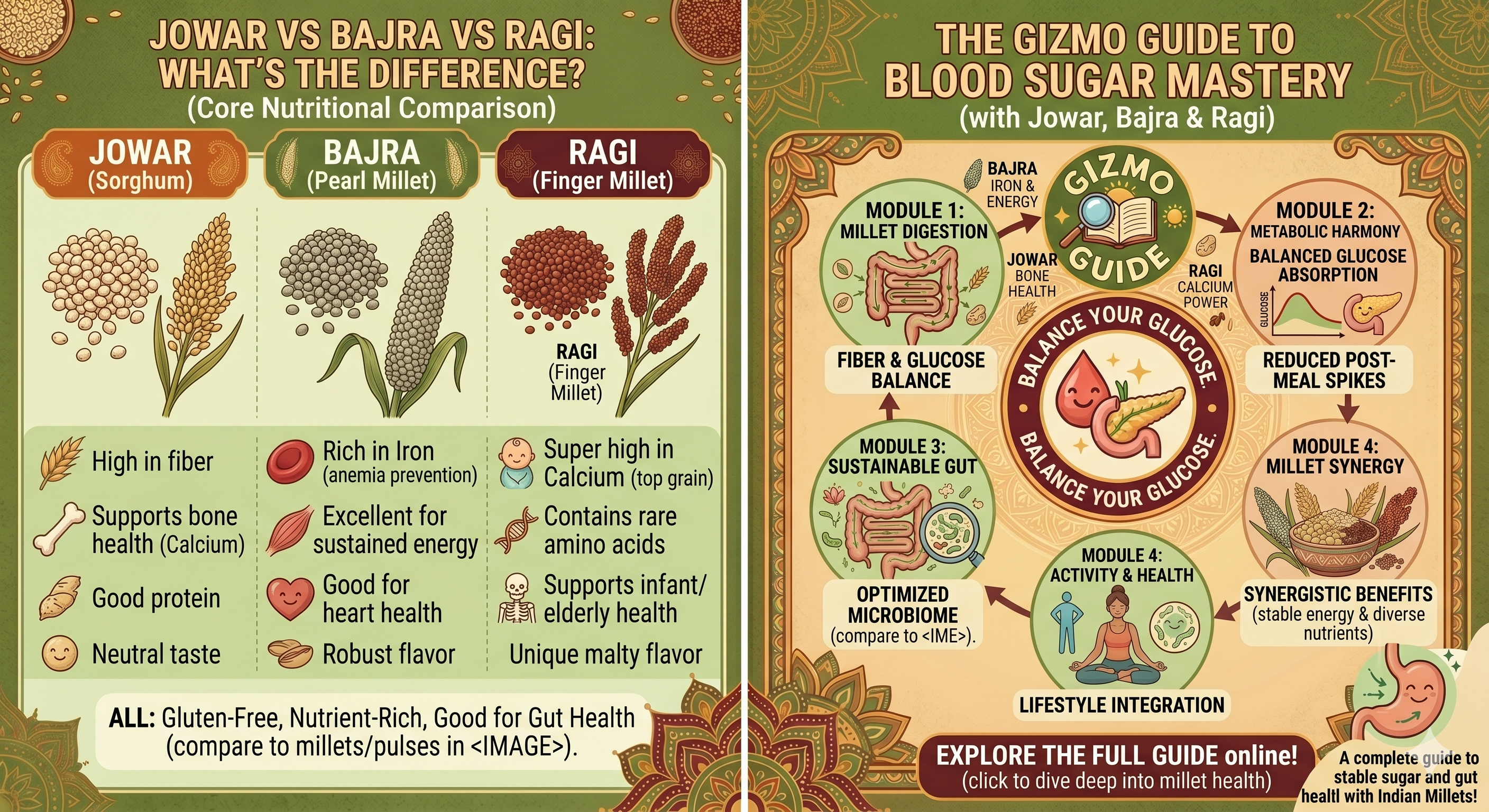
Jowar vs Bajra vs Ragi: What's the Difference?
Walk into any health store or browse any nutrition website today and you'll see millets everywhere. But 'millets' is actually an umbrella term for a large family of ancient grains...
The GRASA Nutrition Team
April 23, 2026
Walk into any health store or browse any nutrition website today and you'll see millets everywhere. But 'millets' is actually an umbrella term for a large family of ancient grains — and each one has a distinct nutritional profile, taste, texture, and best use.
If you're trying to figure out which millet is right for you, this guide breaks down the three most popular and widely available millets in India: Jowar (Sorghum), Bajra (Pearl Millet), and Ragi (Finger Millet).
Quick Overview
| Jowar | Bajra | Ragi | |
|---|---|---|---|
| Hindi Name | Jowar | Bajra | Ragi / Nachni |
| English Name | Sorghum | Pearl Millet | Finger Millet |
| Colour | White/cream | Grey-yellow | Dark brown/red |
| Taste | Mild, neutral | Earthy, slightly bitter | Nutty, slightly sweet |
| Best Season | Year-round | Winter | Year-round |
| Protein (per 100g) | 10.4g | 11.6g | 7.3g |
| Calcium (per 100g) | 25mg | 42mg | 364mg |
| Iron (per 100g) | 4.1mg | 8mg | 3.9mg |
| Glycemic Index | ~62 | ~54 | ~68 |
| Gluten-Free | Yes | Yes | Yes |
Jowar (Sorghum) — The All-Rounder
What makes it special?
Jowar is one of the most versatile millets and the easiest to incorporate into a modern diet. It has a mild, neutral flavour — making it suitable for people who find the stronger taste of bajra off-putting. Jowar atta makes soft rotis that closely resemble wheat rotis in texture.
Key nutritional benefits:
- Rich in antioxidants — jowar contains tannins and polyphenols that reduce oxidative stress
- Good source of B vitamins — supports energy metabolism and nervous system health
- High in phosphorus — important for bone health and cellular energy
- Contains 3-Deoxyanthocyanidins — compounds with potential anti-cancer properties
Best for:
- People new to millets (easiest transition from wheat)
- Those with digestive sensitivity or IBS
- Everyday rotis, bhakri, porridge, or even dosas
Caution: Jowar has a slightly higher GI than bajra (~62), so people with serious blood sugar concerns may benefit from combining it with bajra or ragi rather than using jowar alone.
Bajra (Pearl Millet) — The Warming Powerhouse
What makes it special?
Bajra is nature's answer to cold winters and physical labour. It's the most energy-dense of the three millets, and traditionally consumed in winter months across Rajasthan, Gujarat, and Punjab. Bajra has a distinctly earthy, strong flavour that takes some getting used to — but its nutritional density is unmatched.
Key nutritional benefits:
- Highest protein content of the three millets (~11.6g per 100g)
- Richest in iron — important for anaemia prevention, especially in women
- Excellent source of magnesium — which improves insulin sensitivity and heart health
- Contains zinc — crucial for immune function and wound healing
- Lowest glycemic index (~54) — the best option for blood sugar management
Best for:
- Women (especially those with iron-deficiency anaemia)
- People managing diabetes or prediabetes
- Those with high cholesterol or heart health concerns
- Active individuals or those doing physical work
Caution: Bajra is considered 'heaty' in Ayurveda and should be consumed in moderation during summer months. It also has a strong flavour, so mixing it with jowar atta (50/50) is a good way to ease into it.
Ragi (Finger Millet) — The Calcium Champion
What makes it special?
Ragi is truly one of nature's most extraordinary foods. It contains more calcium than milk — 364mg per 100g vs approximately 120mg in milk. For a country where osteoporosis and bone health are growing concerns, ragi deserves far more attention than it receives.
Key nutritional benefits:
- Highest calcium content of any grain — essential for bones, teeth, and muscle function
- Rich in essential amino acids — particularly methionine, which is rare in plant foods
- High in dietary fibre — one of the best millets for gut health and satiety
- Contains tryptophan — which the body converts to serotonin, supporting mood and sleep
- Naturally cooling — traditionally used in South India during summer
Best for:
- Children and teenagers (bone development)
- Post-menopausal women (bone density protection)
- People with anxiety, poor sleep, or mood issues
- Infants and toddlers (ragi porridge is a traditional first food)
- Weight management (extremely high satiety value)
Caution: Ragi has a slightly higher GI than jowar or bajra (~68), so people with advanced diabetes should monitor portions. However, its high fibre content largely offsets the GI impact in practice.
Which Millet Is Right for You?
| Your Goal | Best Millet |
|---|---|
| Transition from wheat easily | Jowar |
| Manage blood sugar / diabetes | Bajra |
| Improve bone health / calcium | Ragi |
| Treat iron deficiency / anaemia | Bajra |
| Lose weight & reduce hunger | Ragi |
| Improve gut health & digestion | Jowar or Ragi |
| Increase energy & physical stamina | Bajra |
| Children's nutrition | Ragi |
| General everyday eating | Mix of all three |
Can You Mix Them?
Absolutely — and you should. At GRASA, our atta blends combine jowar, bajra, ragi, and other ancient grains in proportions that are designed for your specific health goals. Mixing millets gives you a broader nutritional profile and makes the transition from wheat flour far more sustainable.
A simple starting blend: 40% jowar + 40% bajra + 20% ragi. This gives you a neutral taste from jowar, protein and iron from bajra, and calcium from ragi — all in one roti.
How GRASA Uses These Millets
All GRASA products are built on these three millets — along with other ancient grains like foxtail millet, little millet, and barnyard millet. Our grains are sourced directly from farmers, processed minimally to preserve nutrients, and delivered fresh to your home three times a week. Our nutritionist team determines which blend is right for your body, your health goals, and your lifestyle — and updates your plan as your body responds.
${gutResetCTA}Final Word
Jowar, bajra, and ragi are not interchangeable. Each has unique strengths, and knowing which one serves your needs can make a significant difference to your health outcomes. But here's the most important thing: any of the three is significantly better than refined wheat flour for most people. The best millet is the one you'll actually eat consistently. Start there.
Found this helpful? Share it with your network.
Related Visuals
Share this Article
Explore GRASA
Fermented atta and sourdough bread crafted for gut health and metabolic wellness.
Shop NowOr WhatsApp: +91 9870263399
Explore More Articles
GRASA Recognised as India's Emerging Health Tech & Nutrition Innovation Startup of the Year — Rashtriya Ratna Samman 2026
GRASA Millets & Foods Pvt Ltd — India's first food-led metabolic recovery system built on fermented millets — has been awarded the Emerging Health Tech & Nutrition Innovation Startup of the Year at the Rashtriya Ratna Samman 2026.
Read More →Millets vs Wheat: Which Is Better for Digestion?
If you often feel bloated, sluggish, or heavy after meals, the problem might not be how much you eat — it could be what you eat.
Read More →Best Foods for Blood Sugar Control in India
India is now the diabetes capital of the world. Over 100 million Indians live with diabetes, and an estimated 136 million are in the 'pre-diabetic' zone — at risk but not yet diagnosed.
Read More →THE PCOS-GUT CONNECTION: WHY YOUR HORMONES CANNOT HEAL WITHOUT FIXING THIS FIRST
If you have PCOS and feel like you are doing everything right but nothing is working — your gut microbiome may be why. Here is the science, and what to do about it.
Read More →