GUT HEALTH AND THYROID: THE CONNECTION YOUR DOCTOR MAY NOT HAVE HAD TIME TO EXPLAIN
Millions of Indians take thyroid medication daily but still feel exhausted, bloated and foggy. The missing piece is often the gut. Here is the science.
GRASA Team
March 14, 2026
Hypothyroidism is one of the most diagnosed conditions in urban India — particularly in women. An estimated 42 million Indians live with thyroid disorders. Most of them are on levothyroxine and told to take it on an empty stomach, avoid certain foods, and get their TSH checked every 6 months.
What most are not told: the gut plays a central role in thyroid function — from the absorption of thyroid medication to the conversion of T4 into the active T3 hormone. If your gut is not in good health, your thyroid treatment may be working at significantly reduced efficiency.
How the Gut Affects Thyroid Function — The Three Mechanisms
Mechanism 1: Medication Absorption
Levothyroxine absorption occurs primarily in the small intestine. The state of your gut lining — whether it is inflamed, permeable, or colonised by bacteria that interfere with absorption — directly affects how much of your medication actually reaches your bloodstream.
Studies have shown that gut dysbiosis can reduce levothyroxine absorption by up to 30%, meaning many patients are functionally under-medicated despite technically correct dosing.
Mechanism 2: T4 to T3 Conversion
The thyroid gland primarily produces T4 — the inactive form of the hormone. T4 must be converted to T3, the active form, to have its effect on metabolism, energy, and cognitive function.
This conversion happens in multiple tissues — but approximately 20% of it depends on gut bacteria. Specifically, gut bacteria produce an enzyme called intestinal sulfatase that facilitates T3 conversion. When the gut microbiome is depleted, this conversion pathway is impaired.
Mechanism 3: Immune Regulation
Approximately 80% of the immune system resides in the gut. Hashimoto's thyroiditis — the most common cause of hypothyroidism in India — is an autoimmune condition where the immune system attacks thyroid tissue.
The gut microbiome plays a central role in immune regulation. A gut with high bacterial diversity and low inflammatory bacteria is associated with more regulated immune responses and reduced autoimmune activity.
Signs Your Thyroid and Gut May Both Need Attention
- You are on thyroid medication but still feel exhausted and foggy
- Your TSH levels are "normal" but your symptoms persist
- You experience chronic bloating, constipation, or irregular digestion
- You have multiple food sensitivities or reactions
- Your thyroid dosage has needed frequent adjustments
What Fermented Foods Do for Thyroid Patients
Fermented foods that introduce live Lactobacillus cultures into the gut serve thyroid health in three practical ways:
- They increase gut bacteria diversity, supporting the T4-to-T3 conversion pathway.
- They strengthen the gut lining, reducing intestinal permeability that can trigger or worsen autoimmune responses in Hashimoto's.
- They reduce the inflammatory bacterial strains associated with increased intestinal permeability and compromised medication absorption.
Importantly, for thyroid patients, fermented grains are preferable to raw cruciferous vegetables (like broccoli or kale smoothies) as a gut health intervention — because raw goitrogens in some vegetables can interfere with thyroid function when consumed in large quantities.
Practical Dietary Guidance for Thyroid Patients in India
You do not need to change everything. Small, consistent changes to daily staples matter more than dramatic dietary overhauls that last two weeks.
- Replace regular atta with fermented atta in your daily roti. The fermentation process improves mineral bioavailability — particularly selenium and zinc, which are cofactors in thyroid hormone synthesis.
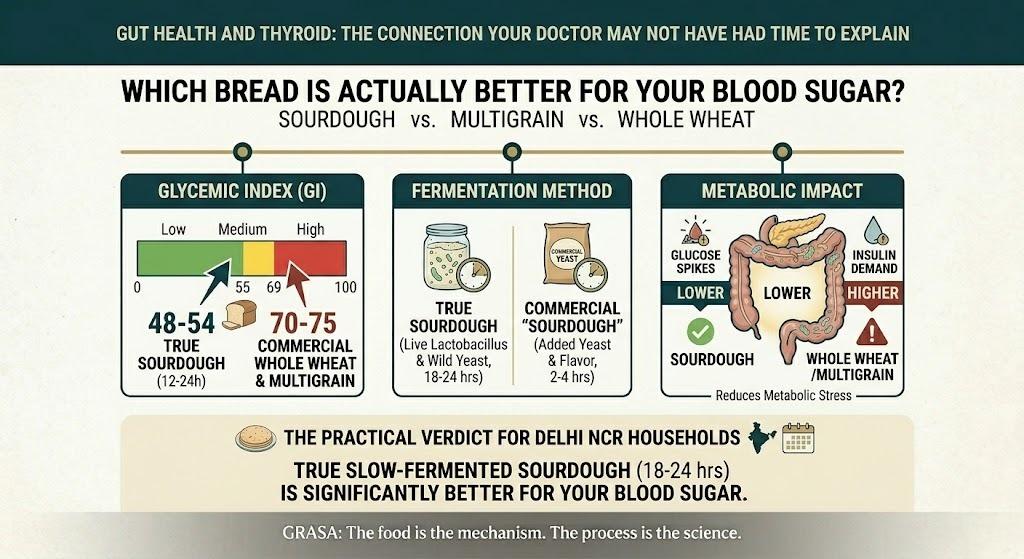
- Introduce properly fermented sourdough bread if bread is part of your breakfast routine. The lower glycemic response reduces cortisol spikes that stress thyroid function.
- Eat your levothyroxine as directed — and then consider what you eat 30-60 minutes later. A breakfast with fermented grain and adequate protein is a better follow-up than a high-fibre smoothie that may affect medication absorption.
Note: Dietary changes for thyroid health should be discussed with your endocrinologist. GRASA products are designed to complement, not replace, your thyroid treatment.
GRASA fermented atta and sourdough bread — made for gut health, designed for daily life in Delhi NCR.
Order on grasamillets.com
Found this helpful? Share it with your network.
Related Articles
Share this Article
Explore GRASA
Fermented atta and sourdough bread crafted for gut health and metabolic wellness.
Shop NowOr WhatsApp: +91 9870263399
Explore More Articles
GRASA Recognised as India's Emerging Health Tech & Nutrition Innovation Startup of the Year — Rashtriya Ratna Samman 2026
GRASA Millets & Foods Pvt Ltd — India's first food-led metabolic recovery system built on fermented millets — has been awarded the Emerging Health Tech & Nutrition Innovation Startup of the Year at the Rashtriya Ratna Samman 2026.
Read More →Millets vs Wheat: Which Is Better for Digestion?
If you often feel bloated, sluggish, or heavy after meals, the problem might not be how much you eat — it could be what you eat.
Read More →Best Foods for Blood Sugar Control in India
India is now the diabetes capital of the world. Over 100 million Indians live with diabetes, and an estimated 136 million are in the 'pre-diabetic' zone — at risk but not yet diagnosed.
Read More →Jowar vs Bajra vs Ragi: What's the Difference?
Walk into any health store or browse any nutrition website today and you'll see millets everywhere. But 'millets' is actually an umbrella term for a large family of ancient grains...
Read More →