
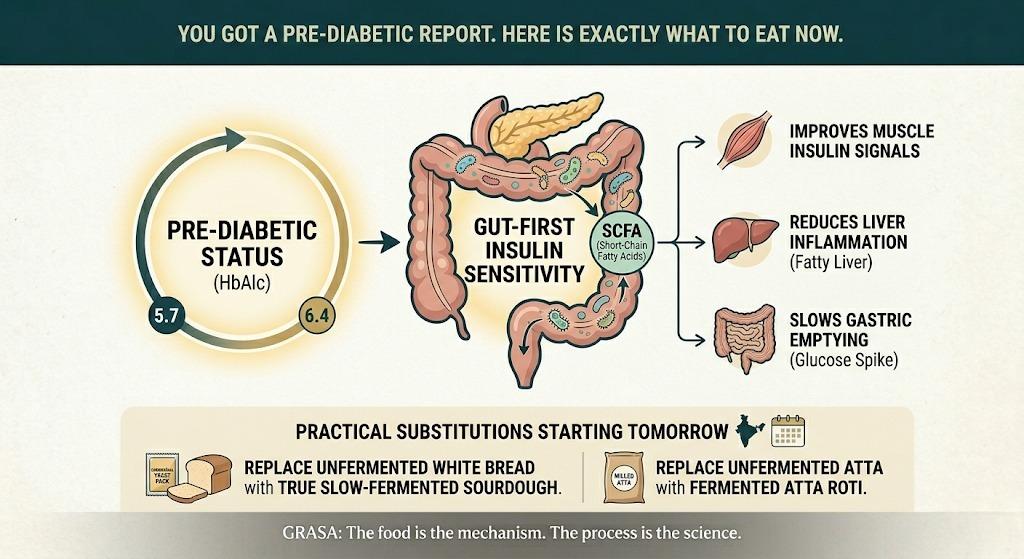
YOU GOT A PRE-DIABETIC REPORT. HERE IS EXACTLY WHAT TO EAT NOW.
A pre-diabetic diagnosis is not a life sentence. The right food changes can reverse it. Here is a clear, practical Indian diet plan based on gut science — not generic advice.
GRASA Team
March 12, 2026
HbA1c between 5.7 and 6.4. Fasting glucose slightly elevated. Your doctor said the words "pre-diabetic" and handed you a diet advice sheet. You left the clinic feeling a combination of fear, confusion, and mild disbelief.
You are not alone. India has over 136 million people in the pre-diabetic range. Urban Delhi NCR has one of the highest prevalence rates in the country — driven by chronic stress, sedentary work, ultra-processed food, and air quality that directly affects metabolic function.
The good news — and this is genuinely good news — is that pre-diabetes is the only stage of this metabolic progression where food can make a decisive difference. This is your window. Let us use it correctly.
What Pre-Diabetes Actually Means
Your cells have become less responsive to insulin. When you eat carbohydrates, your blood glucose rises and your pancreas releases insulin to bring it down. In pre-diabetes, the cells are resisting that insulin signal — so glucose stays elevated longer than it should.
The standard advice is to reduce carbohydrates and increase exercise. This is correct but incomplete. What it misses is the role of your gut microbiome in insulin sensitivity.
The Gut-Diabetes Connection Most Doctors Skip
A landmark 2019 study in Nature Medicine found that the gut microbiome composition is directly linked to insulin resistance. Specifically, people with higher levels of SCFA-producing gut bacteria had significantly better insulin sensitivity than those with depleted gut microbiomes.
SCFAs — short-chain fatty acids produced when gut bacteria ferment dietary fibre — do several things that matter for pre-diabetes management:
- They improve the sensitivity of muscle cells to insulin signals.
- They reduce liver inflammation, directly relevant for fatty liver — which co-occurs with pre-diabetes in approximately 60% of cases.
- They slow gastric emptying, which reduces the post-meal glucose spike.
- They communicate with the pancreas through the gut-brain axis, supporting better insulin secretion timing.
This means that eating foods that actively feed and diversify your gut bacteria is not a nice-to-have for pre-diabetes management. It is a clinical priority.
The Problem With Standard Indian Bread and Atta
The typical roti made with commercially milled, unfermented atta has a glycemic index of approximately 62-70. It digests quickly, causing a rapid glucose spike. For a pre-diabetic, every roti at every meal is a glucose stress event.
This does not mean stop eating rotis. This is India. Rotis are not going away. What it means is that the atta itself can be transformed through fermentation to behave differently in your body.
When atta is slowly fermented with live Lactobacillus cultures before use, three things happen:
- The glycemic index drops by approximately 25-30% compared to unfermented atta — because fermentation partially breaks down the starch structure.
- Phytic acid — which blocks mineral absorption and contributes to nutritional deficiency — is significantly reduced.
- The fermentation process produces beneficial bacteria and organic acids that, when consumed, directly support gut microbiome diversity.
What the Pre-Diabetic Diet in India Should Actually Look Like
Here is a practical framework — not a calorie-counted meal plan, but a principle-based approach that works with Indian food culture:
Principle 1: Replace, Do Not Eliminate
Do not try to remove carbohydrates from your diet entirely. This creates stress, reduces adherence, and is unnecessary. Instead, replace high-glycemic staples with lower-glycemic fermented alternatives. Regular atta roti becomes fermented atta roti. White bread becomes properly fermented sourdough bread. This single substitution, made daily, compounds over weeks and months.
Principle 2: Eat for Your Gut First
Every meal should contain something that feeds your gut bacteria. This means fibre from vegetables, resistant starch from cooled cooked rice or potatoes, and fermented foods. Your gut bacteria convert this into the SCFAs that improve your insulin sensitivity.
Principle 3: Protein at Every Meal
Protein slows glucose absorption and reduces the glycemic impact of the meal. Dal, paneer, eggs, curd — at least one source of protein at every main meal.
Principle 4: The Sequence Matters
Research shows that eating fibre and protein before carbohydrates in a meal significantly reduces the post-meal glucose spike — by up to 37% in some studies. Start your meal with salad or a small bowl of dal before the roti. This one habit change requires no dietary sacrifice.
The Role of Sourdough Bread in Pre-Diabetes Management
Sourdough made through proper slow fermentation — not the commercial yeast shortcuts sold in most bakeries — has a demonstrated lower glycemic response compared to standard whole wheat bread. A 2008 study in Acta Diabetologica and subsequent research has consistently found that the organic acids produced during sourdough fermentation slow starch digestion and reduce the insulin demand of a meal.
For a pre-diabetic who eats bread at breakfast — which describes millions of urban Indian households — this substitution alone can meaningfully reduce the daily glucose stress load.
What to Do Starting Tomorrow
You do not need a new diet app, a new gym membership, or an expensive supplement protocol. You need to make the food you already eat work better for your metabolic health.
Start with two substitutions: your breakfast bread and your kitchen atta. Make them fermented. Do it for 30 days. Check your fasting glucose at the end. Let the data speak.
GRASA makes fermented atta and sourdough bread in small batches in Delhi NCR.
Specifically designed for metabolic health. Order the Gut Correction Programme on grasamillets.com.
Frequently Asked Questions
Is sourdough bread good for diabetics in India?
Properly fermented sourdough bread — made with slow fermentation, not commercial yeast — has a meaningfully lower glycemic index than standard whole wheat bread. This makes it a better choice for pre-diabetics and diabetics who cannot or will not eliminate bread from their diet.
What is the best atta for pre-diabetic patients?
Fermented atta — specifically atta that has undergone slow lacto-fermentation with live cultures — has a lower glycemic response than standard atta because the fermentation process partially breaks down the starch structure and reduces phytic acid content.
Can gut health affect blood sugar?
Yes. Research consistently shows that gut microbiome composition directly influences insulin sensitivity. Higher levels of SCFA-producing gut bacteria correlate with better blood sugar regulation. Eating fermented foods that support gut microbiome diversity is a clinically relevant strategy for pre-diabetes management.
Found this helpful? Share it with your network.
Related Articles
Share this Article
Explore GRASA
Fermented atta and sourdough bread crafted for gut health and metabolic wellness.
Shop NowOr WhatsApp: +91 9870263399
Explore More Articles
GRASA Recognised as India's Emerging Health Tech & Nutrition Innovation Startup of the Year — Rashtriya Ratna Samman 2026
GRASA Millets & Foods Pvt Ltd — India's first food-led metabolic recovery system built on fermented millets — has been awarded the Emerging Health Tech & Nutrition Innovation Startup of the Year at the Rashtriya Ratna Samman 2026.
Read More →Millets vs Wheat: Which Is Better for Digestion?
If you often feel bloated, sluggish, or heavy after meals, the problem might not be how much you eat — it could be what you eat.
Read More →Best Foods for Blood Sugar Control in India
India is now the diabetes capital of the world. Over 100 million Indians live with diabetes, and an estimated 136 million are in the 'pre-diabetic' zone — at risk but not yet diagnosed.
Read More →Jowar vs Bajra vs Ragi: What's the Difference?
Walk into any health store or browse any nutrition website today and you'll see millets everywhere. But 'millets' is actually an umbrella term for a large family of ancient grains...
Read More →