
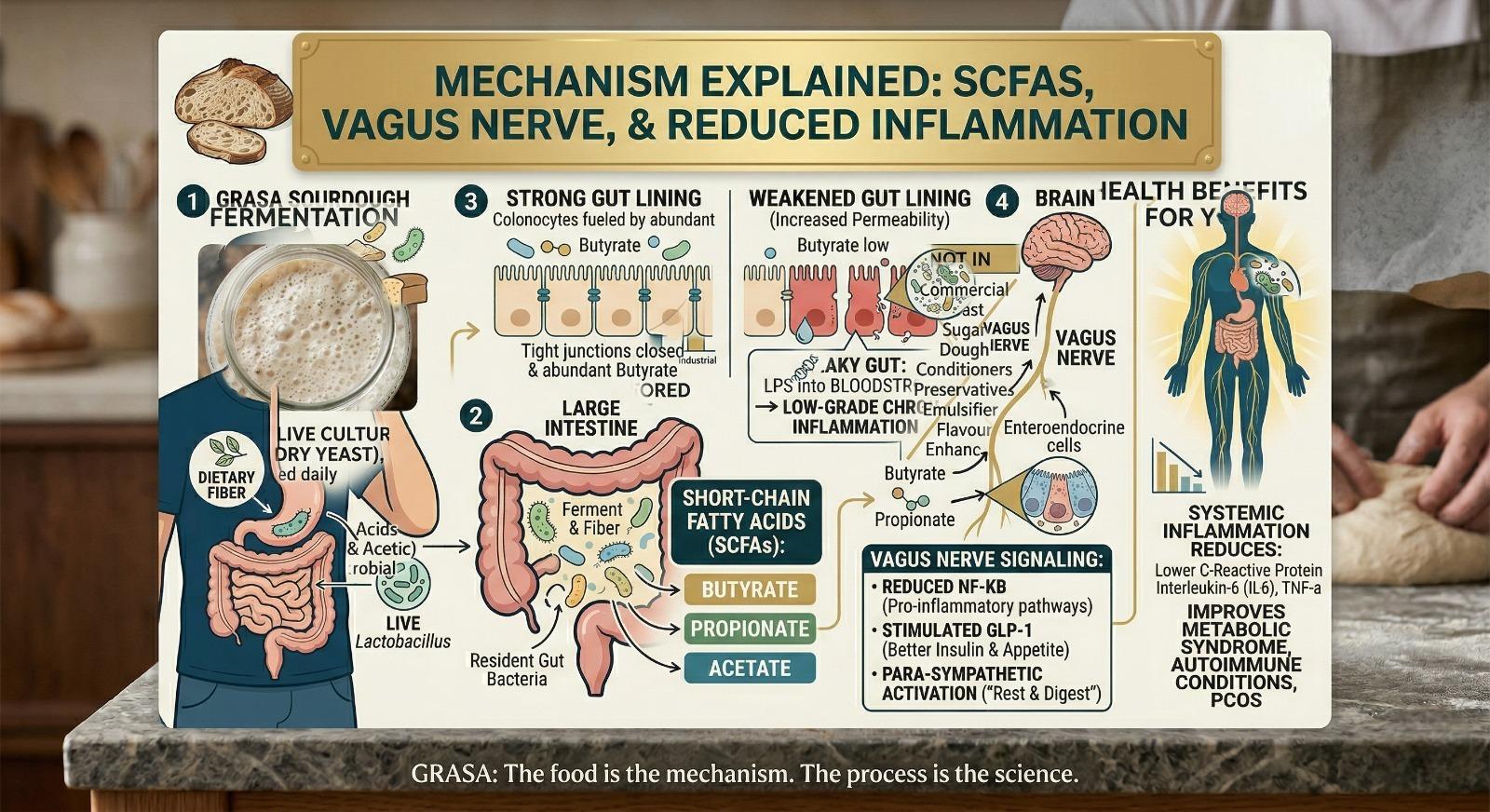
SCFAs, THE VAGUS NERVE, AND WHY FERMENTED FOOD REDUCES INFLAMMATION: THE MECHANISM EXPLAINED
The mechanism behind fermented food and gut health — explained for the scientifically curious. How short-chain fatty acids signal your vagus nerve and reduce systemic inflammation.
GRASA Team
March 19, 2026
Most health content tells you what to eat. Very little explains why — at the level of what is actually happening in your cells. This post is for those who want to understand the mechanism, not just follow the advice.
Here is the chain of events from eating fermented grain to reduced systemic inflammation — step by step.
Step 1: Fermented Grain Enters the Gut
When you eat properly fermented bread or atta, two things enter your digestive system simultaneously: complex carbohydrates (dietary fibre) that your own enzymes cannot fully digest, and live Lactobacillus bacteria introduced through the fermentation process.
Step 2: Gut Bacteria Ferment the Fibre
In your large intestine, your resident gut bacteria — and the Lactobacillus you introduced — ferment the undigested fibre. Fermentation is not a problem. It is the point. The fermentation produces short-chain fatty acids (SCFAs), primarily:
- Butyrate — the most researched SCFA, the primary energy source for the cells lining your colon.
- Propionate — metabolised primarily in the liver, involved in glucose regulation and fatty acid synthesis.
- Acetate — the most abundant SCFA, involved in cholesterol metabolism and peripheral tissue energy.
Step 3: Butyrate Strengthens the Gut Lining
The cells lining your gut (colonocytes) depend on butyrate for approximately 70% of their energy. When butyrate is abundant, the tight junctions between gut cells are strong — meaning the gut wall is intact and selective about what passes through it into the bloodstream.
When butyrate is low — which happens when gut bacteria are depleted or when the diet lacks fermentable fibre — the tight junctions weaken. This is colloquially called "leaky gut" and clinically referred to as increased intestinal permeability.
A permeable gut allows bacterial fragments called lipopolysaccharides (LPS) into the bloodstream. LPS triggers the immune system into a state of low-grade chronic inflammation. This inflammation is the common underlying mechanism in metabolic syndrome, insulin resistance, autoimmune conditions, and chronic fatigue.
Step 4: SCFAs Signal the Vagus Nerve
The vagus nerve is the longest nerve in the body, connecting the brainstem to almost every organ including the gut. It is the primary communication highway of the gut-brain axis.
SCFAs — particularly butyrate and propionate — signal the enteroendocrine cells in the gut lining, which then communicate with the vagus nerve. This communication:
- Reduces the activation of pro-inflammatory immune pathways (specifically NF-κB signalling).
- Stimulates the production of GLP-1 (glucagon-like peptide 1), which improves insulin secretion timing and reduces appetite dysregulation.
- Activates the parasympathetic nervous system — the "rest and digest" state — reducing cortisol output and the chronic stress response that drives inflammation.
Step 5: Systemic Inflammation Reduces
The downstream effect of adequate SCFA production and vagus nerve signalling is a measurable reduction in inflammatory markers — specifically C-reactive protein (CRP), interleukin-6 (IL-6), and tumour necrosis factor alpha (TNF-α). These are the same inflammatory markers elevated in PCOS, pre-diabetes, fatty liver, autoimmune thyroid disease, and chronic metabolic syndrome.
This is why the GRASA brand voice rule exists: always say the mechanism, not just the benefit. "Fermented food reduces inflammation" is a benefit. The chain above is the mechanism. One builds trust. The other invites scepticism.
Why This Matters for What You Put in Your Kitchen
You cannot buy SCFA in a supplement. Your gut bacteria must produce it. And your gut bacteria can only produce it if you give them the right substrate — fermentable fibre from real food — and the right environment — a diverse microbiome with adequate Lactobacillus and Bifidobacterium populations.
Fermented grain staples, consumed daily, create the conditions for this mechanism to operate continuously. Not as a treatment. As a maintenance system for the body you intend to live in for the next 40 years.
GRASA — fermented food built on this science. Small batch. Delhi NCR.
Found this helpful? Share it with your network.
Related Articles
Share this Article
Explore GRASA
Fermented atta and sourdough bread crafted for gut health and metabolic wellness.
Shop NowOr WhatsApp: +91 9870263399
Explore More Articles
GRASA Recognised as India's Emerging Health Tech & Nutrition Innovation Startup of the Year — Rashtriya Ratna Samman 2026
GRASA Millets & Foods Pvt Ltd — India's first food-led metabolic recovery system built on fermented millets — has been awarded the Emerging Health Tech & Nutrition Innovation Startup of the Year at the Rashtriya Ratna Samman 2026.
Read More →Millets vs Wheat: Which Is Better for Digestion?
If you often feel bloated, sluggish, or heavy after meals, the problem might not be how much you eat — it could be what you eat.
Read More →Best Foods for Blood Sugar Control in India
India is now the diabetes capital of the world. Over 100 million Indians live with diabetes, and an estimated 136 million are in the 'pre-diabetic' zone — at risk but not yet diagnosed.
Read More →Jowar vs Bajra vs Ragi: What's the Difference?
Walk into any health store or browse any nutrition website today and you'll see millets everywhere. But 'millets' is actually an umbrella term for a large family of ancient grains...
Read More →