
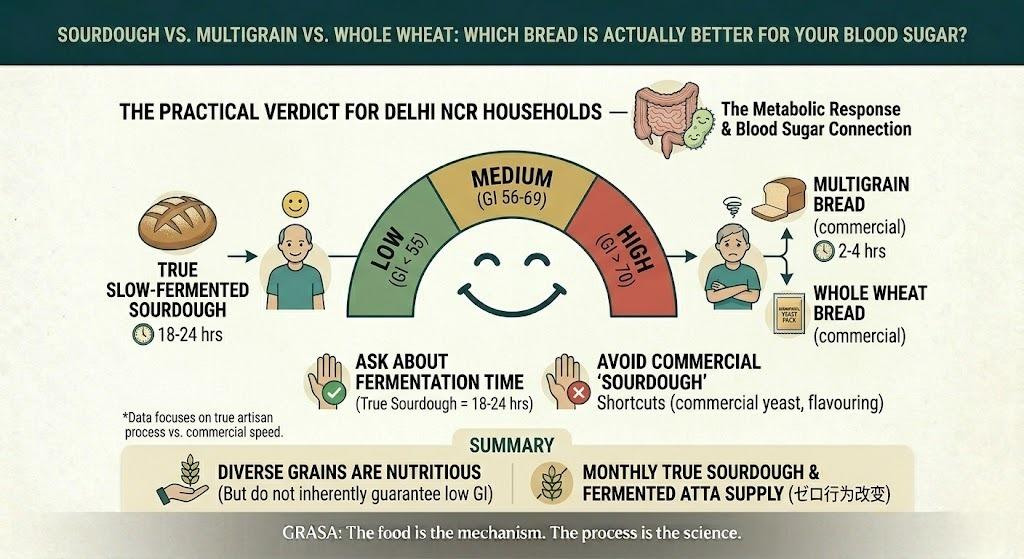
SOURDOUGH VS MULTIGRAIN VS WHOLE WHEAT: WHICH BREAD IS ACTUALLY BETTER FOR YOUR BLOOD SUGAR?
Not all 'healthy' bread is the same. Here is the science of what different breads actually do to your blood glucose — and which one wins for metabolic health in India.
GRASA Team
March 13, 2026
Walk into any premium supermarket in Delhi NCR and you will find breads labelled multigrain, whole wheat, seeded, ancient grain, low GI, and more. The packaging looks serious. The prices suggest health. But what is actually happening to your blood sugar when you eat them?
This post cuts through the packaging claims and looks at what the research actually says about different bread types — specifically in the context of Indian metabolic health concerns like pre-diabetes, PCOS, and fatty liver.
The Glycemic Index: What It Means and Why It Matters
The Glycemic Index (GI) measures how quickly a food raises your blood glucose compared to pure glucose (GI of 100). Foods below 55 are considered low GI. Between 56-69 is medium. Above 70 is high.
For pre-diabetics, PCOS patients managing insulin resistance, and anyone with metabolic concerns, lower GI foods are preferable because they cause a slower, steadier glucose rise — reducing the insulin demand on your pancreas and minimising the glucose spikes that cause metabolic stress over time.
The Bread Comparison — What the Research Shows
| BREAD TYPE | APPROX. GI | WHAT MAKES IT THIS WAY | VERDICT FOR METABOLIC HEALTH |
|---|---|---|---|
| White Bread (standard) | 70–75 | Refined flour, no fermentation, rapid starch digestion. | High glucose spike. Avoid for metabolic concerns. |
| Whole Wheat Bread (commercial) | 65–69 | Whole grain adds some fibre but no fermentation. Starch still digests quickly. | Marginally better. Still causes significant glucose rise. |
| Multigrain Bread (commercial) | 62–68 | Multiple grains but typically no fermentation. GI depends entirely on grain type and processing. | Packaging often overstates health benefit. Similar to whole wheat in glucose impact. |
| Commercial "Sourdough" | 60–65 | Often made with added commercial yeast and very short fermentation. Not true sourdough. | Slightly better than whole wheat. But most commercial sourdough is not properly fermented. |
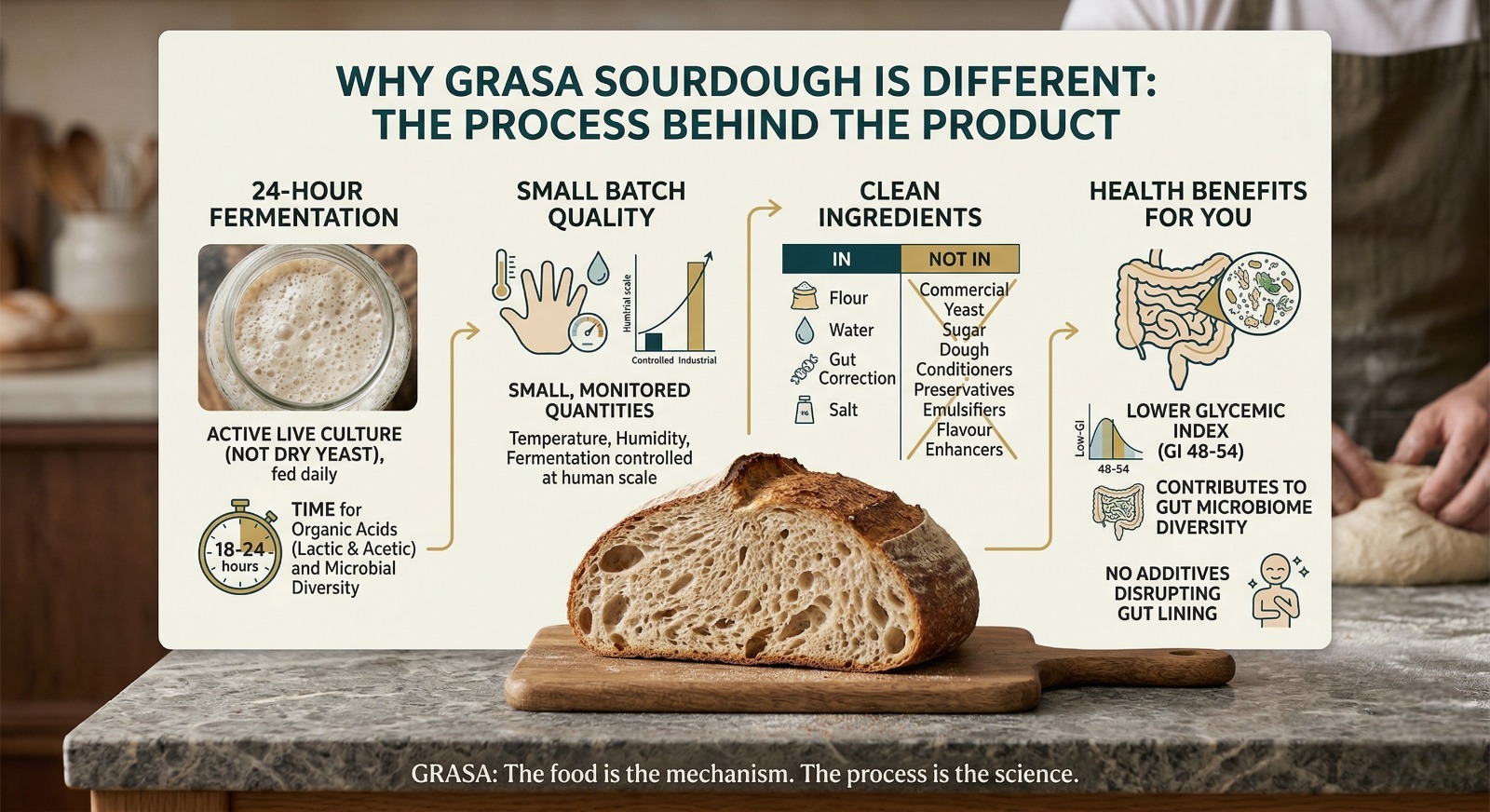
| True Slow-Fermented Sourdough | 48–54 | Long fermentation with live cultures produces organic acids that slow starch digestion significantly. | Meaningfully lower glucose response. Supports gut health. Best bread option for metabolic health. |
Why Most "Sourdough" in Indian Markets Is Not Really Sourdough
This is the critical point that most bread marketing glosses over. True sourdough fermentation requires:
- A live Gut Correction culture — a mixture of wild yeast and Lactobacillus bacteria that has been cultivated and maintained over time.
- A long fermentation period — typically 12-24 hours minimum. This is what produces the organic acids (lactic and acetic acid) that lower the glycemic index and improve digestibility.
- No commercial yeast added to speed up the process.
Most commercially produced "sourdough" bread in India is made with commercial yeast and a small amount of sourdough flavouring or Gut Correction — with a fermentation period of 2-4 hours. This is fast bread. It looks like sourdough and tastes vaguely like sourdough. But it does not deliver the metabolic benefits of true slow fermentation.
The way to identify true sourdough: ask how long the fermentation takes. If the answer is less than 12 hours, it is not delivering the full metabolic benefit. True artisan sourdough takes 18-24 hours minimum.
What About Millet Bread and Gluten-Free Alternatives?
Millet breads have become popular in urban India. They are nutritious in many ways — higher protein, higher fibre, and culturally familiar. However, their glycemic index varies significantly by millet type and preparation method. Jowar (sorghum) has a GI of approximately 55-70 depending on preparation. Bajra (pearl millet) ranges from 55-65.
The key difference: millet breads do not inherently undergo fermentation unless specifically made that way. A slow-fermented millet sourdough would theoretically offer both benefits. But most millet breads available in the Indian market are not fermented — they are just made with different grain.
The Practical Verdict for Delhi NCR Households
If you or someone in your family is managing pre-diabetes, PCOS, fatty liver, or simply wants to reduce the metabolic load of daily bread consumption — the choice is clear. True slow-fermented sourdough, made with live cultures and proper fermentation time, is significantly better than any commercially produced alternative.
The challenge is finding it. Most bakeries — even premium ones — use commercial yeast. Most supermarket sourdough is not true sourdough. The real thing is made in small batches, by people who are serious about the process.
Experience true 24-hour slow-fermented sourdough.
GRASA bakes authentic sourdough in small batches in Delhi NCR — strictly without commercial yeast.
Order on grasamillets.com or WhatsApp +91 9870263399
Found this helpful? Share it with your network.
Related Visuals
Related Articles
Share this Article
Explore GRASA
Fermented atta and sourdough bread crafted for gut health and metabolic wellness.
Shop NowOr WhatsApp: +91 9870263399
Explore More Articles
GRASA Recognised as India's Emerging Health Tech & Nutrition Innovation Startup of the Year — Rashtriya Ratna Samman 2026
GRASA Millets & Foods Pvt Ltd — India's first food-led metabolic recovery system built on fermented millets — has been awarded the Emerging Health Tech & Nutrition Innovation Startup of the Year at the Rashtriya Ratna Samman 2026.
Read More →Millets vs Wheat: Which Is Better for Digestion?
If you often feel bloated, sluggish, or heavy after meals, the problem might not be how much you eat — it could be what you eat.
Read More →Best Foods for Blood Sugar Control in India
India is now the diabetes capital of the world. Over 100 million Indians live with diabetes, and an estimated 136 million are in the 'pre-diabetic' zone — at risk but not yet diagnosed.
Read More →Jowar vs Bajra vs Ragi: What's the Difference?
Walk into any health store or browse any nutrition website today and you'll see millets everywhere. But 'millets' is actually an umbrella term for a large family of ancient grains...
Read More →