
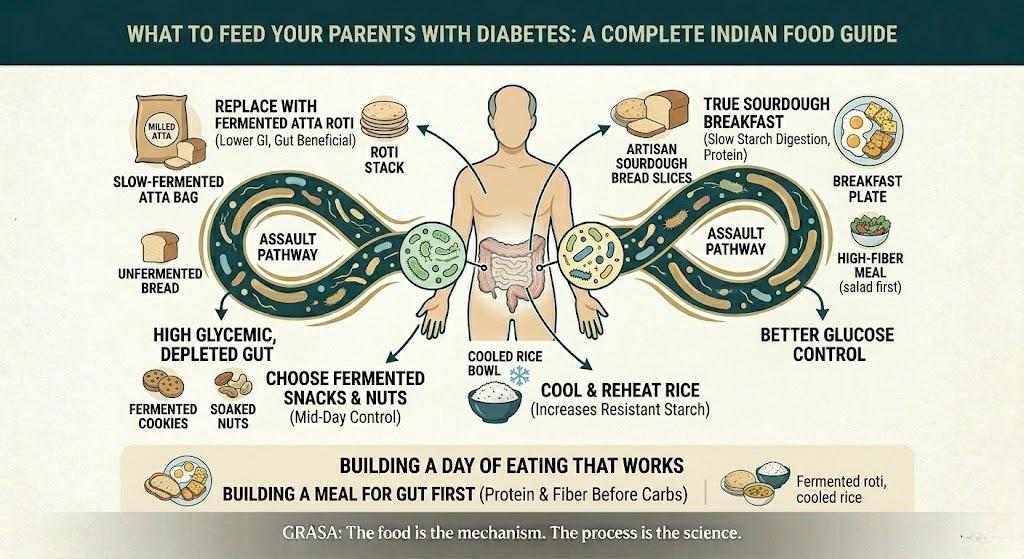
WHAT TO FEED YOUR PARENTS WITH DIABETES: A COMPLETE INDIAN FOOD GUIDE
If your parents have diabetes and you are trying to help them eat better — this is the most practical guide you will find. Real Indian food. Real science. No impossible restrictions.
GRASA Team
March 15, 2026
If one of your parents has recently been diagnosed with Type 2 diabetes — or is managing it long-term — you have probably gone through your own version of this experience: feeling worried, searching for answers, getting conflicting information, and eventually trying to quietly change what is cooked at home without starting a daily argument.
This guide is for you. Not for the person with diabetes — for the adult child who is trying to help, who is navigating this from a distance or from the same kitchen, and who wants practical answers that actually work within a real Indian household.
The First Thing to Understand: You Cannot Change Everything
The biggest mistake well-meaning family members make is trying to revolutionise a 60-year-old's food habits overnight. They remove rice. They replace all rotis with salads. They buy sugar-free everything.
This does not work. Not because your parent is difficult — but because food is deeply tied to identity, culture, routine, and pleasure. Removing it creates resistance, stress, and a feeling of deprivation that often makes compliance worse, not better.
The approach that actually works: substitution, not elimination. Replace the high-glycemic staples with lower-glycemic alternatives that look, taste, and function identically in the kitchen.
The Staples That Matter Most — And What to Replace Them With
Atta (Wheat Flour)
Regular commercially milled atta has a glycemic index of approximately 62–70. Your parents are probably eating 4–6 rotis daily. Each roti is a glucose event. The accumulation matters.
Replace it with slowly fermented atta — atta that has been prepared through lacto-fermentation with live cultures. The fermentation process reduces the glycemic index by approximately 25–30%, reduces phytic acid that blocks mineral absorption, and introduces gut-beneficial bacteria that improve the metabolic response to every meal.
The roti made from fermented atta looks and tastes identical. Your parent will not know the difference — and that is the point.
Bread (if consumed at breakfast)
Many urban North Indian households now have bread at breakfast. Standard white or even whole wheat bread is high glycemic and has no gut benefit.
True slow-fermented sourdough bread — not the commercial sourdough in supermarkets, but properly made artisan sourdough with 18–24 hour fermentation — has a measurably lower glycemic response and introduces beneficial bacteria.
Rice
You do not need to remove rice. Cook it, cool it completely, and reheat before serving. Cooling cooked rice converts a portion of its digestible starch into resistant starch, which the gut bacteria ferment into SCFAs instead of it being absorbed as glucose.
This simple technique can reduce the glycemic impact of rice by 10–15%.
Building a Day of Eating That Actually Works
Breakfast:
True sourdough bread with eggs or paneer + a small bowl of curd. The protein and fat slow glucose absorption. The fermented bread introduces gut bacteria. The curd adds probiotics.
Lunch:
Start with a small bowl of dal or vegetables before the rotis. Research shows eating protein and fibre before carbohydrates reduces post-meal glucose spikes by up to 37%.
Two fermented atta rotis. A vegetable. Curd if desired.
Dinner:
Keep it lighter than lunch. Fermented atta roti with dal and a cooked vegetable. If rice is served, use the cooled-and-reheated method.
Snacks:
The most dangerous blood sugar time for many diabetics is mid-morning and mid-afternoon when they reach for biscuits or namkeen. Replace with a small portion of fermented cookies — lower glycemic, with gut benefit — or a handful of soaked nuts.
The Gut Connection for Diabetic Patients
Research published in Cell Metabolism (2019) found that gut microbiome diversity is a strong independent predictor of blood sugar control — even more predictive than dietary fat or carbohydrate intake alone in some analyses.
Diabetic patients with diverse, healthy gut microbiomes managed their glucose significantly better than those with depleted microbiomes following the same diet.
This means feeding the gut bacteria of your diabetic parent is not a supplementary concern. It is a primary one.
One Simple Rule for the Gifting Moment
If you live separately from your parents and are trying to improve their food without daily supervision — the best intervention is to change what arrives in their kitchen, not to give them a list of what not to eat.
A monthly supply of fermented atta and sourdough bread, delivered to their door, requires zero behaviour change from them. The atta replaces what is already there. The bread replaces what is already being eaten. The gut benefit accumulates silently and consistently.
The GRASA Family Gut Correction Programme — fermented atta, sourdough bread & cookies. The gift your parents will use every single day.
Order on grasamillets.com or WhatsApp +91 9870263399
Found this helpful? Share it with your network.
Related Articles
Share this Article
Explore GRASA
Fermented atta and sourdough bread crafted for gut health and metabolic wellness.
Shop NowOr WhatsApp: +91 9870263399
Explore More Articles
GRASA Recognised as India's Emerging Health Tech & Nutrition Innovation Startup of the Year — Rashtriya Ratna Samman 2026
GRASA Millets & Foods Pvt Ltd — India's first food-led metabolic recovery system built on fermented millets — has been awarded the Emerging Health Tech & Nutrition Innovation Startup of the Year at the Rashtriya Ratna Samman 2026.
Read More →Millets vs Wheat: Which Is Better for Digestion?
If you often feel bloated, sluggish, or heavy after meals, the problem might not be how much you eat — it could be what you eat.
Read More →Best Foods for Blood Sugar Control in India
India is now the diabetes capital of the world. Over 100 million Indians live with diabetes, and an estimated 136 million are in the 'pre-diabetic' zone — at risk but not yet diagnosed.
Read More →Jowar vs Bajra vs Ragi: What's the Difference?
Walk into any health store or browse any nutrition website today and you'll see millets everywhere. But 'millets' is actually an umbrella term for a large family of ancient grains...
Read More →